
Split Flow No Purge Loss Dryer: 7 Powerful Benefits of a Breakthrough Zero-Waste Air Drying Solution
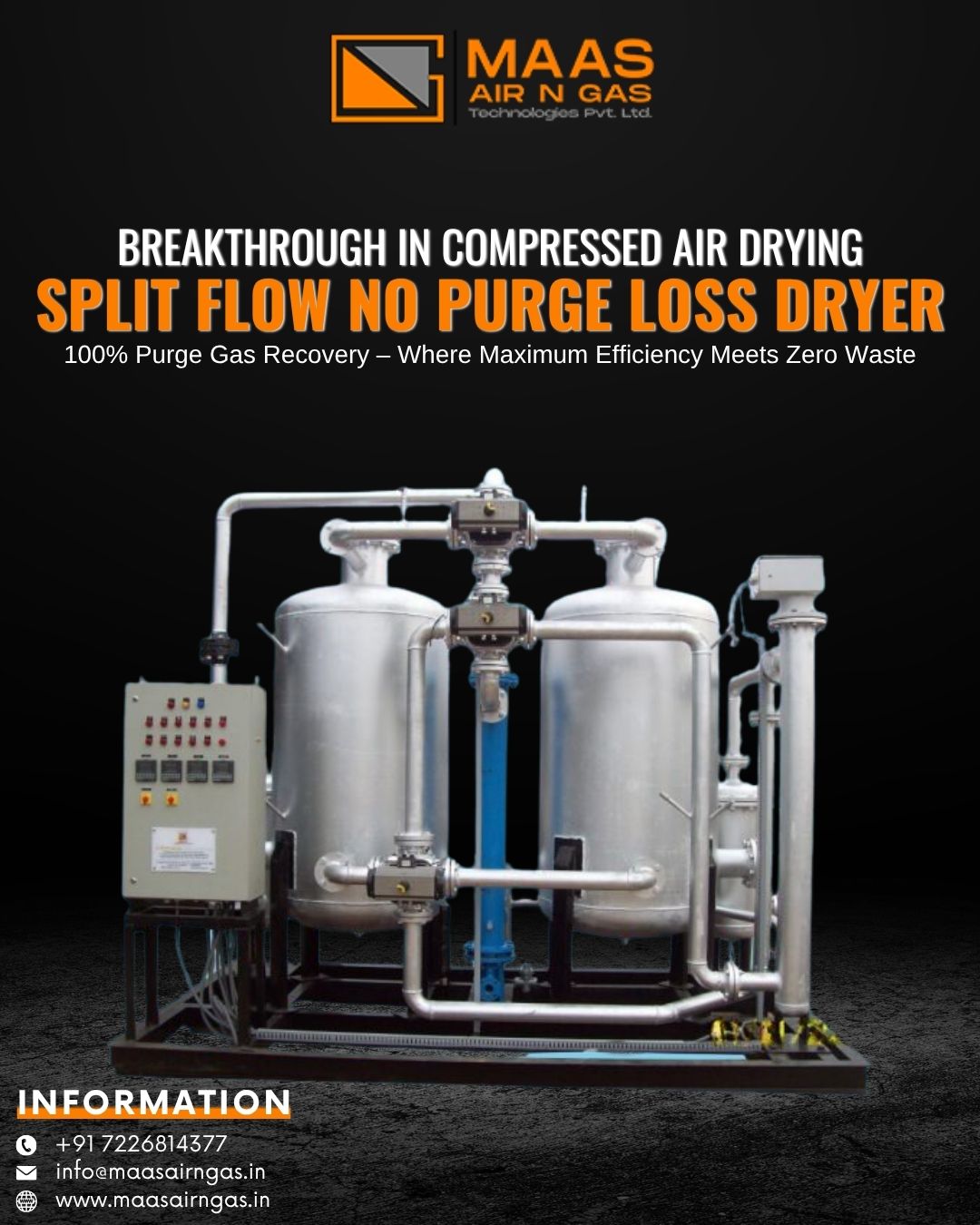
Split Flow No Purge Loss Dryer: The Smart Breakthrough for Maximum Efficiency and Zero Waste
Table of Contents
- What is a Split Flow No Purge Loss Dryer?
- Why compressed air drying matters in industrial operations
- How a Split Flow No Purge Loss Dryer works
- Major benefits of a Split Flow No Purge Loss Dryer
- Applications across industries
- Why energy efficiency and dew point stability matter
- Split Flow No Purge Loss Dryer vs conventional dryers
- Why choose MAAS Air N Gas / Air-N-Gas
- FAQs
- Conclusion
Split Flow No Purge Loss Dryer: A New Standard in Compressed Air Drying
Split Flow No Purge Loss Dryer technology is changing the way industries think about compressed air treatment. In many manufacturing environments, compressed air is not just a utility; it is a core production input. It powers instruments, valves, pneumatic tools, packaging systems, automation lines, process controls, and critical plant operations. Yet the quality of that compressed air often determines whether production remains stable or becomes vulnerable to moisture-related failures, corrosion, pressure fluctuations, poor product quality, and higher maintenance costs. This is where the Split Flow No Purge Loss Dryer becomes a highly valuable solution.
Moisture is one of the most common and damaging contaminants in compressed air systems. When untreated moisture enters pipelines and process equipment, it can corrode pneumatic lines, damage instruments, contaminate end products, spoil sensitive processes, reduce the life of valves and actuators, and create inconsistent performance in the entire air network. Traditional drying systems solve part of the problem, but many of them do so at the cost of purge air loss, extra energy consumption, or higher long-term operating cost. The Split Flow No Purge Loss Dryer addresses this challenge by offering a more efficient way to achieve dry compressed air while recovering performance that would otherwise be lost in conventional regeneration methods.
For industries trying to balance dew point reliability, energy efficiency, air conservation, and operational economy, the Split Flow No Purge Loss Dryer is not just another dryer design. It is a practical upgrade in compressed air drying philosophy. It is built for facilities that want the performance of a desiccant dryer without the recurring penalty of sacrificing a portion of valuable dry compressed air during regeneration.
Why Compressed Air Drying Is So Important in Industrial Plants
Compressed air always contains moisture. The amount depends on ambient temperature, humidity, compressor discharge conditions, and operating pressure. Once air is compressed, the concentration of moisture rises, and unless it is removed properly, that moisture travels into the downstream system. In industrial settings, this can create a long list of avoidable problems.
Wet compressed air can cause internal rusting in pipelines, water carryover in pneumatic equipment, clogging in control systems, product contamination, instrument malfunction, and unstable process performance. In sectors such as pharmaceuticals, food processing, electronics, medical gas support systems, packaging, and precision engineering, moisture control is not optional. It is directly tied to quality, compliance, uptime, and safety. Even in general engineering applications, excessive moisture can shorten the life of tools, increase maintenance frequency, and lead to expensive shutdowns.
According to the Bureau of Energy Efficiency (BEE), compressed air systems are significant energy consumers in industry, and system efficiency depends heavily on how well the compressed air network is designed, operated, and maintained. That makes dryer selection an energy decision as much as a process decision. Choosing the right dryer affects not only moisture removal but also operating cost, compressor loading, pressure stability, and overall plant efficiency.
What Is a Split Flow No Purge Loss Dryer?
A Split Flow No Purge Loss Dryer is an advanced desiccant air dryer used for drying compressed air or gas streams while minimizing or eliminating the loss of already dried compressed air during regeneration. In conventional heatless desiccant dryers, a part of the dry outlet air is diverted as purge air to regenerate the saturated desiccant bed. While effective, that method wastes a portion of expensive compressed air that has already been generated, filtered, compressed, and dried.
The Split Flow No Purge Loss Dryer works differently. Instead of consuming dry product air as purge, it uses a controlled split of incoming wet air. A portion of this wet air is heated, which increases its moisture-carrying capacity, and then it is passed through the saturated desiccant bed for regeneration. After regeneration, moisture is condensed and removed, and the regenerated air stream is brought back into the system. This approach significantly reduces wastage and helps deliver the “no purge loss” advantage that industries look for in high-efficiency compressed air systems. Product descriptions associated with Air-N-Gas and comparable split-flow systems describe this same basic operating principle and its role in reducing purge loss while maintaining effective desiccant regeneration.
How a Split Flow No Purge Loss Dryer Works
The operating principle of a Split Flow No Purge Loss Dryer is based on desiccant adsorption combined with controlled regeneration using heated split flow. In simple terms, the incoming wet compressed air is divided into two streams. One larger portion moves toward the drying cycle where moisture is adsorbed by the active desiccant bed. The second portion is routed through a heater. Once heated, this air gains a higher capacity to carry moisture. It is then directed through the saturated desiccant bed to regenerate it by removing the trapped moisture.
After passing through the desiccant during regeneration, the moisture-laden air is cooled in an aftercooler so that the moisture condenses and can be drained out. The treated regeneration stream is then returned and mixed back into the inlet stream or system loop, depending on the design. The result is a dryer that achieves desiccant regeneration without consuming valuable dry product air in the way a traditional purge dryer does.
This operating concept matters because every cubic meter of compressed air has a production cost. Compressors consume power, filtration systems add pressure drop, and poor air management increases the burden on the entire system. If a dryer can achieve low dew point performance while reducing compressed air wastage, the impact on plant economics can be substantial over time.
Key Benefits of a Split-Flow No-Purge Loss Dryer
1. No Purge Air Loss Means Better Air Economy
One of the strongest reasons industries choose a Split Flow No Purge Loss Dryer is right in the name: it is designed to avoid the continuous loss of valuable dried compressed air during regeneration. In large plants where compressed air demand is constant and expensive, this benefit directly improves air utilization and reduces avoidable waste.
2. Lower Operating Cost Over the Long Term
Compressed air is often described as one of the costliest utilities in a plant. When a conventional dryer uses a portion of dry compressed air for purge, that air has already been compressed using electrical energy. Losing it means paying again for replacement air. A Split Flow No Purge Loss Dryer helps cut that hidden loss and can reduce total lifecycle cost in suitable applications.
3. Reliable Low Dew Point Performance
Industrial processes that require dry air need stable dew point control. A Split Flow No Purge Loss Dryer is built for desiccant-based low dew point performance, which is essential where moisture-sensitive equipment, process quality, and corrosion prevention matter. In many systems, dew point levels around -40°C can be achieved, supporting critical compressed air quality requirements.
4. Reduced Risk of Contamination
Because the regeneration strategy does not rely on outside purge air in the same way some other systems do, the process can be more controlled. Certain split flow no purge loss dryer designs also help avoid contamination risks associated with external air handling in some industrial environments. Product references for Air-N-Gas highlight this as a practical advantage.
5. Economical for Higher Capacities
Split flow systems are often considered especially practical for larger air capacities where purge losses from traditional dryers become expensive over time. In high-flow industrial installations, even a small percentage of purge loss translates into meaningful energy and air cost. Recovering that value is one of the strongest business cases for a Split Flow No Purge Loss Dryer.
6. Strong Fit for Continuous Industrial Operation
Plants running 24/7 cannot afford unstable air quality or moisture carryover. A Split Flow No Purge Loss Dryer is well suited for continuous-duty applications where air quality consistency matters as much as energy performance. Its design supports dependable moisture removal for instrumentation, process air, and critical utility lines.
7. Better System-Level Efficiency
Dryer efficiency should not be judged only by whether it removes moisture. It should also be judged by how much pressure drop it creates, how much compressed air it wastes, how much maintenance it demands, and how reliably it protects downstream equipment. A properly selected Split Flow No Purge Loss Dryer improves the full compressed air system, not just the drying step.
Where a Split Flow No Purge Loss Dryer Is Used
A Split Flow No Purge Loss Dryer is used in a wide range of industries where dry compressed air is essential for production reliability, product quality, and equipment protection. In pharmaceutical plants, dry air helps protect formulations, packaging integrity, and process control systems. In food and beverage facilities, moisture-free compressed air is important for hygienic operations and packaging performance. In automotive and engineering plants, dry air supports painting, pneumatic tools, automation systems, and control equipment. In chemical and petrochemical operations, moisture control is critical for instrumentation reliability and process stability.
The same applies to electronics manufacturing, gas handling systems, hospitals and medical support utilities, textile operations, printing lines, and precision manufacturing environments. Any facility dealing with corrosion-sensitive pneumatic circuits, low-temperature dew point requirements, or costly compressor power consumption can evaluate the value of a Split Flow No Purge Loss Dryer.
Split Flow No Purge Loss Dryer vs Conventional Desiccant Dryer
A conventional heatless desiccant dryer is simple and widely used, but it normally sacrifices a portion of dried air for regeneration. That makes it effective, yet not always economical in plants where compressed air cost is a major concern. An internally heated dryer can reduce purge air use, but depending on design and process demand, a Split Flow No Purge Loss Dryer can offer an even stronger case where zero or near-zero purge loss is a priority.
The real difference lies in how regeneration is managed. Traditional systems often consume dried compressed air. A Split Flow No Purge Loss Dryer uses a split-flow regeneration strategy to preserve product air and reduce wastage. For plants evaluating lifecycle cost rather than just purchase price, this difference can be decisive. Over months and years of operation, the savings from reduced air loss, stable dew point performance, and improved compressor utilization can outweigh the initial investment.
Why Energy Efficiency Matters in Compressed Air Drying
Compressed air systems are notorious for hidden inefficiencies. Power is spent to compress air, cool it, filter it, store it, distribute it, and then condition it to the required quality. If a dryer wastes part of that air, the entire system must work harder to make up the difference. That is why the choice of a Split Flow No Purge Loss Dryer is not only about drying quality; it is about system economics.
The Bureau of Energy Efficiency (BEE) notes that compressed air systems account for significant electricity use in Indian industries and that only a fraction of input energy reaches the point of end use efficiently if systems are not optimized. A dryer that reduces purge loss contributes directly to better compressed air efficiency. It can lower unnecessary compressor loading, reduce wasted utility generation, and support more disciplined energy management in industrial plants. This is particularly relevant for manufacturers trying to reduce operating expenditure, improve sustainability, and align with modern energy efficiency goals.
For readers who want a broader government-backed view of compressed air efficiency, you can refer to the Bureau of Energy Efficiency guidance on compressed air systems here: BEE compressed air system reference
Why Choose MAAS Air N Gas / Air-N-Gas for a Split Flow No Purge Loss Dryer
When investing in a Split Flow No Purge Loss Dryer, the machine itself is only part of the decision. The real value comes from process understanding, correct sizing, dependable manufacturing, quality components, desiccant selection, automation, after-sales support, and the ability to match the dryer to the actual operating conditions of the plant.
MAAS Air N Gas and Air-N-Gas Process Technologies position themselves as specialized players in air and gas process systems, with experience across air dryers, gas generators, filtration, and related industrial solutions. Their public company and product materials describe expertise in adsorption-based systems, compressed air drying units, and industrial gas process equipment.
Why customers consider working with MAAS Air N Gas / Air-N-Gas
- Experience in adsorption-based air and gas systems
- Capability to support industrial compressed air drying requirements
- Product understanding across air dryers, gas generators, and allied process systems
- Focus on performance, moisture control, and application-specific solutions
- Support for industries looking for efficient, low-dew-point compressed air treatment
For businesses evaluating advanced compressed air treatment systems, explore our range of air dryers and industrial gas solutions at Air-N-Gas Process Technologies and learn more about the company’s engineering background on the About page.
To discuss the right Split Flow No Purge Loss Dryer configuration for your plant, visit MAAS Air N Gas and connect with the team for application-specific guidance.
How to Select the Right Split Flow No Purge Loss Dryer
Choosing the right Split Flow No Purge Loss Dryer should begin with application analysis rather than catalogue comparison alone. The correct system depends on air flow, operating pressure, inlet temperature, required dew point, ambient conditions, duty cycle, contamination load, and downstream process sensitivity. A dryer that is oversized may increase capital cost unnecessarily, while an undersized dryer may compromise dew point stability and desiccant life.
It is also important to consider filtration quality, pre-treatment, moisture load variation, cooling arrangement, heater controls, valve reliability, and automation logic. The best supplier will ask detailed questions about your compressed air demand pattern rather than simply quoting a generic model. That is the difference between buying a machine and installing a working compressed air solution.
FAQs About Split Flow No Purge Loss Dryer
1. What is a Split Flow No Purge Loss Dryer?
A Split Flow No Purge Loss Dryer is an advanced desiccant-based compressed air drying system designed to remove moisture from compressed air without sacrificing valuable dry air as purge. Instead of using a portion of already dried compressed air for regeneration, it uses a split flow method in which part of the incoming wet air is heated and used for desiccant regeneration, helping reduce wastage and improve overall efficiency.
2. Why is it called a no-purge loss dryer?
It is called a no-purge loss dryer because it minimizes or eliminates the loss of dry compressed air during regeneration. In conventional desiccant dryers, a percentage of dried air is typically used to regenerate the desiccant bed, which leads to energy and air loss. A Split Flow No Purge Loss Dryer is designed to avoid that loss and improve compressed air utilization.
3. What dew point can a Split Flow No Purge Loss Dryer achieve?
A properly designed Split Flow No Purge Loss Dryer can typically achieve low dew point performance around -40°C, depending on operating conditions, system design, desiccant quality, pressure, temperature, and application requirements.
4. Which industries use Split Flow No Purge Loss Dryer systems?
These dryers are widely used in pharmaceuticals, chemicals, petrochemicals, manufacturing, electronics, food processing, automotive plants, instrumentation air systems, gas processing, and other moisture-sensitive industrial applications.
5. Why is a Split Flow No Purge Loss Dryer better than a standard desiccant dryer in some applications?
It can be better because it helps reduce purge air loss, lowers compressed air wastage, supports stable dew point performance, improves energy efficiency, and becomes especially economical in larger-capacity industrial air systems where air conservation and operating cost control matter.
Conclusion
The Split Flow No Purge Loss Dryer represents a practical and high-value advancement in compressed air drying for industries that cannot afford moisture problems or unnecessary compressed air wastage. By using a split-flow regeneration concept rather than sacrificing dried product air as purge, it delivers a strong combination of low dew point performance, energy-conscious operation, reduced air loss, and improved long-term operating economy.
For plants focused on productivity, air quality, utility savings, and dependable process performance, the Split Flow No Purge Loss Dryer is more than a product feature. It is a strategic compressed air solution. Whether the requirement comes from pharmaceuticals, food processing, chemicals, engineering, automotive, or instrumentation air applications, the ability to remove moisture without throwing away expensive compressed air makes this dryer a compelling choice.
If your plant is evaluating a more efficient way to protect compressed air systems, reduce operating losses, and achieve reliable low-dew-point air, a properly engineered Split Flow No Purge Loss Dryer from an experienced process technology manufacturer can be the right next step.