
Refrigerator Air Dryer: 7 Powerful Benefits for Reliable Industrial Moisture Control
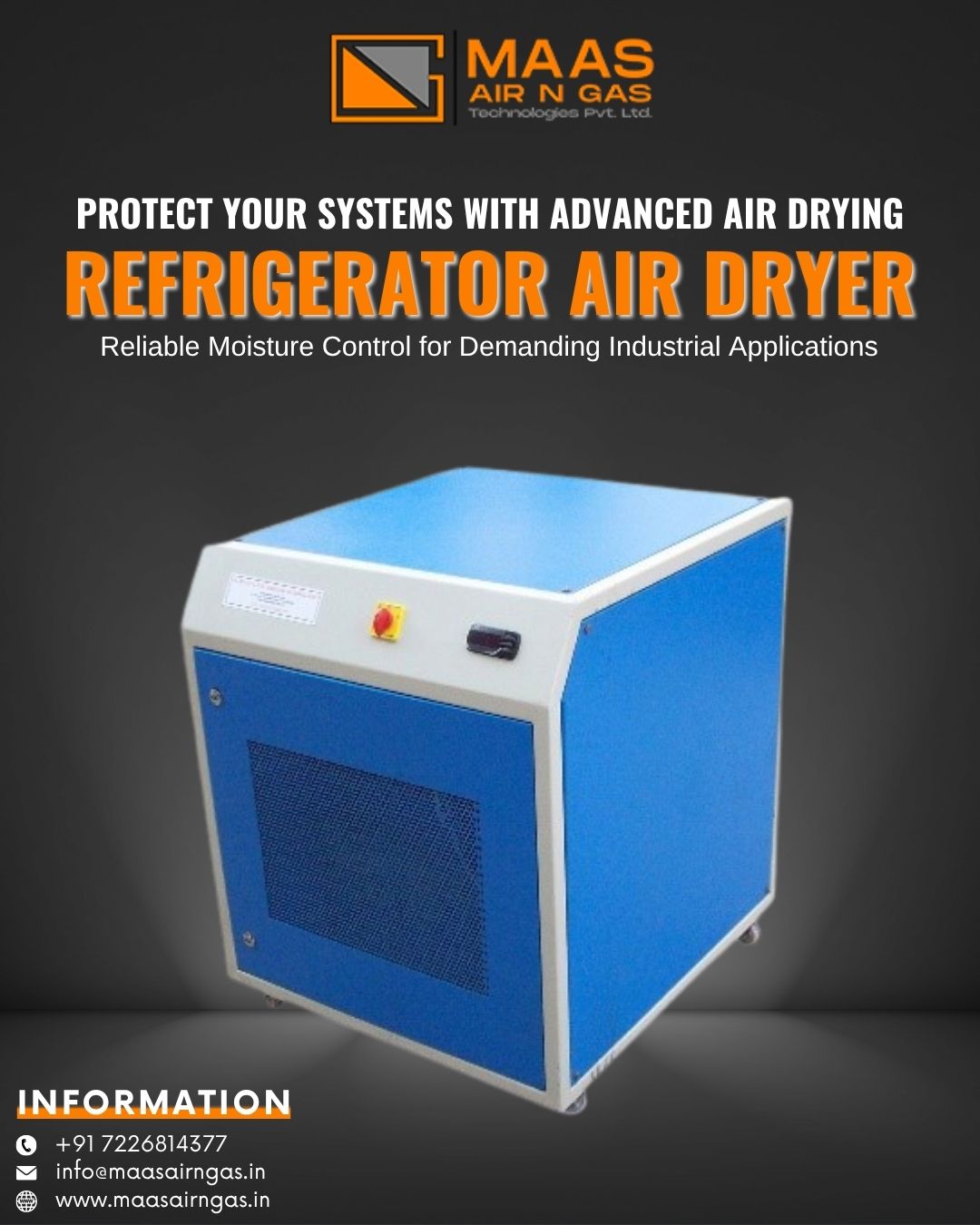
Refrigerator Air Dryer: 7 Powerful Benefits for Reliable Industrial Moisture Control
Table of Contents
- What is a Refrigerator Air Dryer?
- Why Moisture in Compressed Air is a Serious Industrial Problem
- How a Refrigerator Air Dryer Works
- Key Benefits of a Refrigerator Air Dryer
- Applications of Refrigerator Air Dryer in Industry
- How to Choose the Right Refrigerator Air Dryer
- Why Choose Air-N-Gas for Refrigerator Air Dryer Solutions
- FAQs
- Conclusion
Refrigerator Air Dryer for Industrial Compressed Air Systems
What is a Refrigerator Air Dryer?
Refrigerator Air Dryer is one of the most practical and widely used solutions for removing moisture from compressed air systems in industrial operations. In every compressed air network, ambient air contains water vapour. When air is compressed, the concentration of this moisture increases, and if it is not removed, it condenses inside pipelines, air receivers, pneumatic tools, valves, cylinders, instruments, and production equipment. Over time, this moisture becomes one of the biggest hidden causes of corrosion, product quality issues, machine downtime, and maintenance expense.
A Refrigerator Air Dryer works by lowering the temperature of compressed air so that water vapour condenses and can be separated from the air stream. This simple but highly effective process allows industries to maintain a consistent supply of clean, dry air for everyday production use. It is a preferred choice for facilities that need dependable moisture control without the higher operating complexity of advanced drying systems.
For manufacturers that rely on compressed air every day, a Refrigerator Air Dryer is not just an accessory. It is a protective system that helps maintain the health of the entire air network. Whether the application is powering pneumatic machines, supporting packaging lines, controlling automation systems, or protecting process equipment, dry compressed air directly contributes to productivity, safety, and system longevity.
At Air-N-Gas, compressed air treatment is part of a broader industrial offering that includes gas generators, filters, dryers, after-coolers, receivers, and related process technologies. The company’s air dryer range includes refrigerated and desiccant-based systems, while its dedicated refrigerated air dryer page describes a solution designed for low operating cost, low noise, zero purge loss, and a 3°C pressure dew point.
Why Moisture in Compressed Air is a Serious Industrial Problem
Many plants underestimate the damage caused by moisture in compressed air until it begins affecting production. The problem starts at the compressor intake. Atmospheric air always contains some amount of humidity. Once this air is compressed, the moisture becomes concentrated, and as the temperature changes across the system, water begins to condense. If that moisture enters the air distribution network untreated, it can damage multiple parts of the plant at the same time.
Inside pipelines, moisture promotes internal rusting and scale formation. In pneumatic equipment, it can wash away lubrication, cause sticky valve operation, damage seals, and reduce actuator performance. In precision instruments and control systems, even a small amount of water can affect calibration, create unstable readings, or interrupt automation. In product-contact or process-sensitive sectors, moisture contamination can also create quality issues, especially where dry air is expected for packaging, material handling, spraying, or process support.
Government and energy-industry guidance consistently notes that compressed air systems need proper air treatment and moisture management for efficient, reliable operation. The U.S. Department of Energy’s compressed air resources highlight the importance of maintaining air quality and improving compressed air system performance, while energy-efficiency guidance on compressed air also emphasises that ancillary equipment, such as dryers, has a direct impact on system performance and operating cost.
This is where a Refrigerator Air Dryer becomes essential. Removing moisture before it can circulate through the system, it helps preserve line integrity, stabilise operations, reduce unscheduled maintenance, and extend the service life of downstream equipment.
How a Refrigerator Air Dryer Works
The operating principle of a Refrigerator Air Dryer is straightforward, which is one of the reasons it remains so popular across industries. The dryer cools the incoming compressed air using a refrigeration circuit. As the air temperature drops, water vapour condenses into liquid droplets. These droplets are then separated from the air in a moisture separator and discharged through a drain system. The dry air is subsequently delivered to the plant network for use.
Air-N-Gas describes its refrigerated air dryer as a system in which compressed air passes through a heat interchanger while refrigerant at around 3°C flows through the other side. At that temperature, most of the moisture condenses and is then separated and drained out. The company lists benefits such as simple non-cyclic operation, low operating cost, low noise, zero purge loss, suitability for different capacities, electronic control, and environmentally friendly refrigerant.
This mode of drying is highly effective for general industrial compressed air applications because it balances performance, simplicity, and cost. Unlike certain adsorption-based systems that may require purge air or regeneration energy, a Refrigerator Air Dryer is typically selected where the required dew point is moderate and the focus is on dependable day-to-day moisture removal.
Another important point is energy performance. Refrigerated air dryers do add some energy load to a compressed air system, but energy-efficiency programs note that modern, well-selected refrigerated dryers with appropriate controls can moderate energy use effectively. Refrigerated air dryers are specifically recognised as a standard method of water vapour removal in industrial compressed air systems.
7 Powerful Benefits of a Refrigerator Air Dryer
1. Protects Equipment from Corrosion and Moisture Damage
A Refrigerator Air Dryer significantly reduces the amount of water entering the compressed air line. This protects pipelines, air receivers, cylinders, tools, and pneumatic machinery from rust and internal corrosion. When moisture is removed at the source, the entire system becomes more stable and less vulnerable to long-term damage.
2. Improves Product Quality and Process Reliability
In many industrial environments, compressed air directly or indirectly affects production quality. Moisture in the air line can disrupt spray finishing, packaging operations, automation, instrument air performance, and other sensitive applications. Dry air supports consistency and reduces the risk of process interruptions caused by water carryover.
3. Reduces Maintenance and Downtime
Moisture-related failures are often repetitive and expensive. A Refrigerator Air Dryer helps reduce clogged filters, sticky valves, water accumulation, corroded fittings, and premature wear in downstream equipment. Over time, that means fewer breakdowns, lower maintenance frequency, and better machine availability.
4. Delivers Cost-Effective Drying for General Industrial Use
For most standard industrial compressed air requirements, a Refrigerator Air Dryer offers an efficient balance of performance and operating cost. It is particularly attractive where the application does not require ultra-low dew point air but still demands reliable moisture removal.
5. Supports Better Air System Efficiency
Water in compressed air systems can worsen pressure drop, create contamination issues, and increase stress on downstream components. A properly sized Refrigerator Air Dryer helps keep the system cleaner and more predictable, which contributes to smoother operation of the complete compressed air network.
6. Simple Working Principle and Easy Integration
One of the strongest advantages of a Refrigerator Air Dryer is operational simplicity. It can be integrated into new or existing compressed air systems with relative ease, and because the technology is familiar across industrial maintenance teams, operation and servicing are straightforward.
7. Reliable for Continuous Industrial Applications
Industrial facilities need compressed air treatment equipment that can run consistently under daily operating loads. A Refrigerator Air Dryer is well-suited to such environments because it is built for dependable moisture removal without unnecessary complexity. When selected correctly and installed with suitable filtration and condensate drainage, it becomes a long-term reliability asset.
Applications of Refrigerator Air Dryer in Industry
A Refrigerator Air Dryer is used across a broad range of industries because compressed air is one of the most common industrial utilities. Manufacturing plants use it to protect pneumatic tools, actuators, and control lines. Automotive and engineering facilities rely on dry compressed air for assembly equipment, painting support, and workshop utilities. Textile and packaging plants use it to avoid moisture-related interruptions in production. Food and beverage support utilities, plastics processing units, fabrication workshops, and general process industries also benefit from moisture-free air.
The value of a Refrigerator Air Dryer increases further when the plant environment is humid, when compressor systems run continuously, or when downtime is costly. In these cases, the dryer becomes a preventive investment rather than a reactive purchase.
If you are building a broader air treatment line, it also makes sense to review the wider product range from Air-N-Gas Air Dryer Solutions, where the company lists refrigerated air dryers, heatless air dryers, internally heated dryers, HOC dryers, split-flow no purge loss dryers, blower regenerated dryers, and low-pressure dryers. For plants that require standard compressed air drying, the dedicated Refrigerated Air Dryer page at Air-N-Gas is the most relevant internal reference.
How to Choose the Right Refrigerator Air Dryer
Selecting the right Refrigerator Air Dryer should never be based on price alone. The dryer must match the actual compressed air demand, pressure conditions, ambient temperature, inlet air temperature, and expected air quality requirement of the plant. A unit that is undersized may fail to control moisture under peak load, while an oversized system can increase capital cost without delivering meaningful benefits.
The first factor to review is flow capacity. The dryer should be sized according to the compressor output and real operating demand, not just nameplate assumptions. The second factor is pressure dew point requirement. For most general industrial applications, the dew point delivered by a Refrigerator Air Dryer is sufficient, but the process should still be evaluated carefully. The third factor is pressure drop, because excessive pressure drop across the dryer increases energy cost and can affect downstream performance. The fourth factor is serviceability, including drain arrangement, control system, maintenance access, and availability of after-sales support.
Industry references on compressed air dryer selection also stress the importance of understanding dew point, efficiency, and application suitability before choosing a dryer type.
For buyers comparing solutions, it is also useful to look at how the manufacturer supports the full air treatment package. A dryer performs best when integrated with suitable filtration, moisture separation, and system design support. That is one reason manufacturers with broader compressed air expertise often add more value than a seller offering only a standalone machine.
Why Choose Air-N-Gas for Refrigerator Air Dryer Solutions
When a business invests in a Refrigerator Air Dryer, it is not only buying a machine; it is choosing a supplier for system reliability, technical guidance, and long-term support. This is where Air-N-Gas positions itself strongly. According to the company website, Air-N-Gas has more than 19 years of experience in adsorption-based gas separation systems, air filters, air dryers, and related process technologies, and presents itself as an ISO 9001 certified organisation serving industrial requirements in air and gas systems.
Air-N-Gas offers more than a single dryer model. Its product ecosystem includes air dryers, gas generators, filters, after coolers, auto drain valves, air receivers, pressure vessels, and water chillers, which is useful for customers who want a coordinated compressed air and gas solution rather than a fragmented procurement process.
The company’s refrigerated air dryer page highlights several practical features that matter to industrial buyers: low operating cost, low noise, zero purge loss, suitability for multiple capacities, electronic control, and environmentally friendly refrigerant. These are commercially relevant points because they align with what most plants look for—reliable drying, manageable operating cost, and easy integration into existing compressor systems.
Another reason to consider Air-N-Gas is the availability of internal product continuity. A customer who starts with a Refrigerator Air Dryer may later need filtration, a desiccant dryer, a receiver, or gas generation equipment. Having a supplier that already works across these categories can simplify technical coordination and after-sales support.
To strengthen topical authority and SEO trust, add these dofollow external references inside the blog:
- Government / authority link: U.S. Department of Energy – Compressed Air Systems
- Industry reference: Atlas Copco guide on choosing a compressed air dryer
These links support the technical importance of moisture control, dryer selection, compressed air efficiency, and air quality management.
FAQs About Refrigerator Air Dryer
1. What is a Refrigerator Air Dryer used for?
A Refrigerator Air Dryer is used to remove moisture from compressed air by cooling the air and condensing water vapour. It protects pneumatic tools, pipelines, valves, and process equipment from corrosion, water damage, and performance loss.
2. What dew point does a Refrigerator Air Dryer typically provide?
A standard Refrigerator Air Dryer generally provides a pressure dew point of around 3°C, which is suitable for most general industrial compressed air applications. Air-N-Gas also highlights a PDP of 3 Deg C for its refrigerated air dryer product page.
3. Is a Refrigerator Air Dryer suitable for all industries?
A Refrigerator Air Dryer is ideal for a wide range of industries such as manufacturing, automotive, pharmaceuticals support systems, food processing utilities, packaging, engineering plants, and textile operations where dry compressed air is required for stable system performance.
4. What is the difference between a Refrigerator Air Dryer and a Desiccant Air Dryer?
A Refrigerator Air Dryer removes moisture by cooling compressed air and is best for standard industrial applications. A desiccant air dryer is used when ultra-low dew point air is required for highly sensitive or critical processes.
5. Why is moisture removal so important in compressed air systems?
Moisture can cause rust, pipeline corrosion, product contamination, instrument malfunction, valve sticking, pressure drops, and frequent maintenance issues. Removing water vapour improves reliability, air quality, and overall equipment life.
Conclusion
A Refrigerator Air Dryer is one of the most important components in any compressed air system where moisture control, equipment protection, and operating reliability matter. Compressed air naturally carries water vapour, and once that moisture enters pipelines and machines, it can trigger corrosion, maintenance problems, production instability, and unnecessary operating costs. Installing the right Refrigerator Air Dryer helps prevent those issues by removing condensable moisture before it damages the system.
For industrial users looking for a practical, reliable, and cost-effective drying solution, a Refrigerator Air Dryer remains a strong choice for general-purpose compressed air treatment. It supports cleaner air, better process consistency, longer equipment life, and lower downtime risk. When backed by a supplier with broader compressed air and gas process expertise, the value of the investment becomes even stronger.
Air-N-Gas offers a relevant solution for businesses that want dependable air drying backed by experience in industrial air and gas systems. If your goal is to protect compressors, pipelines, tools, automation lines, and downstream equipment from the effects of moisture, a properly selected Refrigerator Air Dryer can be a highly effective long-term asset.