
PSA Nitrogen Gas Generation Plant: Cost-Effective On-Site Nitrogen Production Solution
Introduction
Nitrogen is one of the most widely used industrial gases across manufacturing, food processing, pharmaceuticals, electronics, chemical processing, and metal fabrication industries. Traditionally, businesses have relied on nitrogen cylinders or bulk liquid nitrogen deliveries to meet their operational requirements. However, rising transportation costs, supply chain challenges, and storage concerns have encouraged industries to adopt more efficient alternatives.
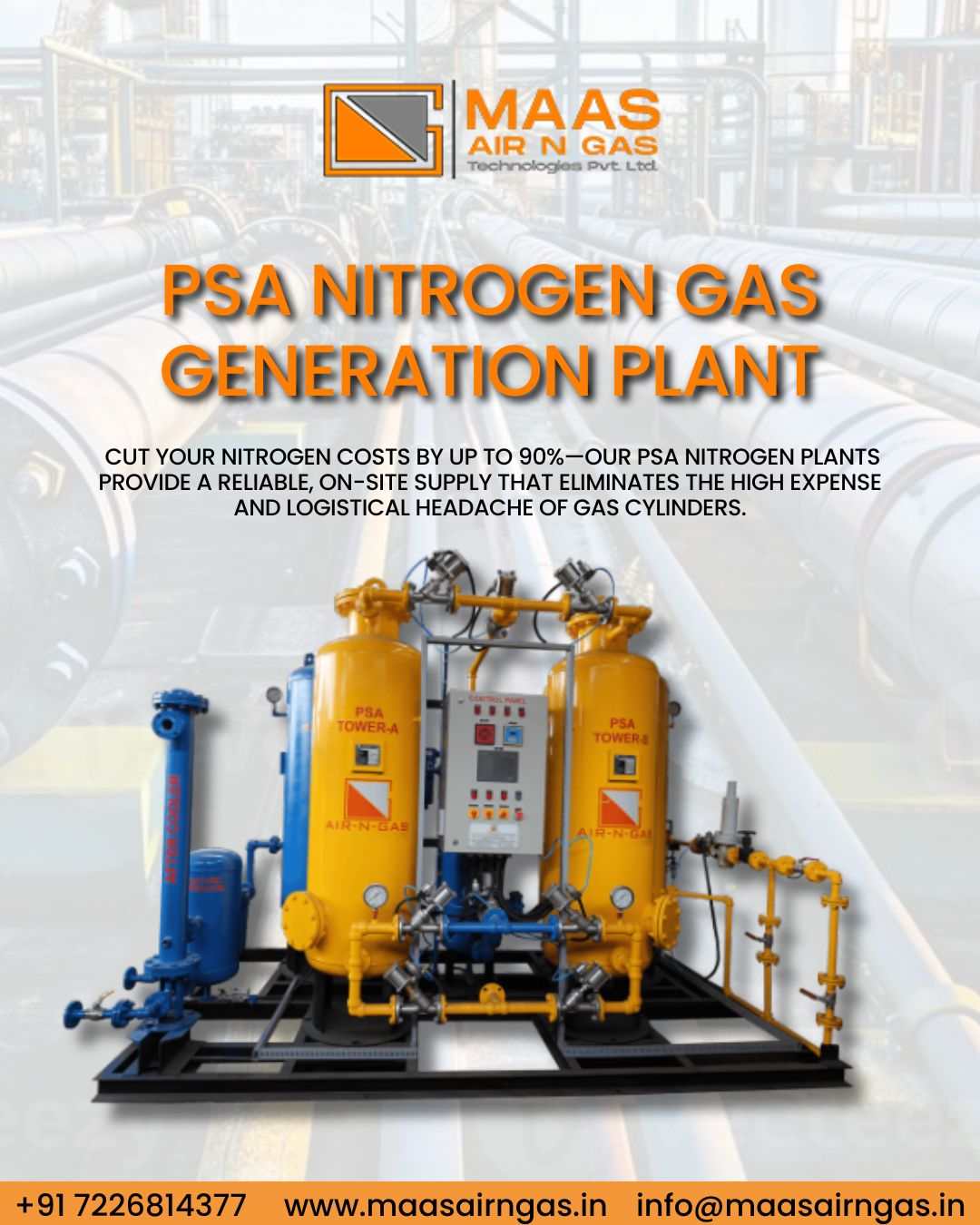
A PSA (Pressure Swing Adsorption) Nitrogen Gas Generation Plant offers a reliable and economical solution by producing nitrogen directly at the point of use. This advanced system helps organizations achieve a continuous nitrogen supply while significantly reducing operational expenses and eliminating dependence on external suppliers.
In this blog, we explore how PSA Nitrogen Gas Generation Plants work, their advantages, applications, and key factors to consider before installation.
Table of Contents
| Sr. No. | Topics |
|---|---|
| 1 | Introduction to PSA Nitrogen Gas Generation Plant |
| 2 | What is PSA Technology? |
| 3 | Working Principle of PSA Nitrogen Plants |
| 4 | Key Features |
| 5 | Benefits of On-Site Nitrogen Generation |
| 6 | Industrial Applications |
| 7 | Components of a PSA Nitrogen Plant |
| 8 | Comparison with Traditional Nitrogen Supply Methods |
| 9 | Factors to Consider Before Installation |
| 10 | Conclusion |
| 11 | FAQs |
PSA Nitrogen Gas Generation Plant
A PSA Nitrogen Gas Generation Plant is an advanced system designed to separate nitrogen from compressed air using Pressure Swing Adsorption technology. The process produces high-purity nitrogen suitable for a wide range of industrial applications.
Unlike conventional nitrogen supply methods, PSA systems generate nitrogen on-site, ensuring uninterrupted availability while reducing long-term operational costs.
What is PSA Technology?
Pressure Swing Adsorption (PSA) is a gas separation process that utilizes Carbon Molecular Sieves (CMS) to selectively adsorb oxygen molecules from compressed air.
The system operates through alternating pressure cycles. While one adsorption vessel produces nitrogen, the second vessel regenerates itself, ensuring continuous nitrogen output.
Key Characteristics of PSA Technology
- High nitrogen purity levels
- Continuous gas production
- Energy-efficient operation
- Automatic control systems
- Minimal maintenance requirements
- Reliable industrial performance
Working Principle of PSA Nitrogen Plants
The operation of a PSA Nitrogen Plant follows a systematic process:
Step 1: Air Compression
Atmospheric air is compressed and filtered to remove dust, oil, and moisture.
Step 2: Air Purification
The compressed air passes through air treatment systems for enhanced purity and equipment protection.
Step 3: Adsorption Process
The purified air enters adsorption vessels containing Carbon Molecular Sieves, where oxygen molecules are trapped.
Step 4: Nitrogen Separation
Nitrogen passes through the CMS bed and is collected for industrial use.
Step 5: Regeneration Cycle
The adsorption vessel regenerates by releasing captured oxygen, preparing it for the next production cycle.
Key Features
| Feature | Description |
|---|---|
| On-Site Production | Generates nitrogen where it is needed |
| High Purity Output | Produces nitrogen up to industrial purity requirements |
| Automated Operation | PLC-based control systems for easy operation |
| Continuous Supply | Uninterrupted nitrogen generation |
| Energy Efficient | Optimized power consumption |
| Compact Design | Space-saving installation |
| Low Maintenance | Minimal servicing requirements |
| Cost Reduction | Significant savings over purchased nitrogen |
Benefits of On-Site Nitrogen Generation
Reduced Operating Costs
Producing nitrogen on-site eliminates recurring cylinder rental, transportation, and delivery expenses.
Improved Supply Reliability
Industries no longer need to worry about delayed deliveries or inventory shortages.
Enhanced Safety
On-site generation reduces handling risks associated with high-pressure cylinders and bulk storage systems.
Operational Efficiency
A continuous nitrogen supply supports uninterrupted production processes.
Environmental Benefits
Reduced transportation requirements contribute to lower carbon emissions and a smaller environmental footprint.
Industrial Applications
PSA Nitrogen Gas Generation Plants are widely used across various industries.
Food and Beverage Industry
Used for packaging, preservation, and oxidation prevention.
Pharmaceutical Industry
Supports manufacturing processes and product quality control.
Electronics Manufacturing
Provides controlled atmospheres for sensitive production operations.
Chemical Processing
Used in inerting, blanketing, and process protection applications.
Metal Processing
Supports laser cutting, welding, and heat treatment applications.
Oil and Gas Industry
Used for pipeline purging and storage tank blanketing.
Components of a PSA Nitrogen Plant
A standard PSA Nitrogen Generation System consists of:
Air Compressor
Supplies compressed air to the system.
Air Dryer
Removes moisture from compressed air.
Air Filters
Eliminate contaminants and improve gas quality.
PSA Towers
Contain Carbon Molecular Sieves for nitrogen separation.
Nitrogen Storage Tank
Stores generated nitrogen for stable supply.
Control Panel
Monitors and controls plant operations.
Comparison with Traditional Nitrogen Supply Methods
| Parameter | PSA Nitrogen Plant | Nitrogen Cylinders | Liquid Nitrogen |
|---|---|---|---|
| Supply Reliability | High | Moderate | Moderate |
| Operating Cost | Low | High | High |
| Transportation Requirement | None | Frequent | Frequent |
| Storage Space | Minimal | Significant | Significant |
| Safety | Improved | Moderate | Moderate |
| Availability | Continuous | Delivery Dependent | Delivery Dependent |
Factors to Consider Before Installation
Before selecting a PSA Nitrogen Gas Generation Plant, businesses should evaluate:
Required Nitrogen Purity
Different industries require varying purity levels depending on the application.
Flow Rate Requirements
Production demands determine the required nitrogen output capacity.
Available Installation Space
Adequate space should be allocated for equipment and maintenance access.
Energy Consumption
Evaluate operating efficiency and long-term power requirements.
Future Expansion Needs
Choose a system that can accommodate future production growth.
Why Industries Prefer PSA Nitrogen Generation Systems
Industries increasingly choose PSA technology because it offers a practical balance between reliability, efficiency, and cost savings. By generating nitrogen on-site, companies gain greater control over production processes while reducing dependence on external suppliers.
The ability to produce nitrogen whenever required makes PSA systems a valuable investment for organizations seeking long-term operational stability.
Conclusion
A PSA Nitrogen Gas Generation Plant provides an efficient and dependable solution for industries that require a continuous supply of nitrogen. By generating nitrogen directly at the point of use, businesses can reduce operating expenses, improve supply reliability, enhance workplace safety, and increase overall productivity.
As industrial demand for nitrogen continues to grow, on-site nitrogen generation remains a practical and cost-effective approach for achieving sustainable and efficient operations.
FAQs
What is a PSA Nitrogen Gas Generation Plant?
A PSA Nitrogen Gas Generation Plant is a system that produces nitrogen from compressed air using Pressure Swing Adsorption technology.
How pure can the nitrogen generated by a PSA plant be?
The purity level depends on system design and application requirements, with options available for various industrial needs.
Is on-site nitrogen generation more economical than cylinders?
Yes, on-site generation can significantly reduce recurring costs associated with nitrogen cylinders and deliveries.
Which industries commonly use PSA nitrogen plants?
Food processing, pharmaceuticals, electronics, chemical manufacturing, metal processing, and oil & gas industries commonly use PSA nitrogen systems.
Does a PSA Nitrogen Plant require extensive maintenance?
No, most systems are designed for reliable operation with relatively low maintenance requirements.
Can PSA Nitrogen Plants operate continuously?
Yes, PSA technology is designed to provide a continuous and uninterrupted nitrogen supply.
What are the major advantages of PSA nitrogen generation?
Cost savings, continuous availability, reduced logistics dependence, improved safety, and operational efficiency are among the primary advantages.
How do I select the right nitrogen generation system?
Consider nitrogen purity requirements, flow rate, available space, energy efficiency, and future expansion plans before choosing a system.