
PSA Biogas Purification Plant: 7 Powerful Benefits for High-Quality Renewable Energy Production
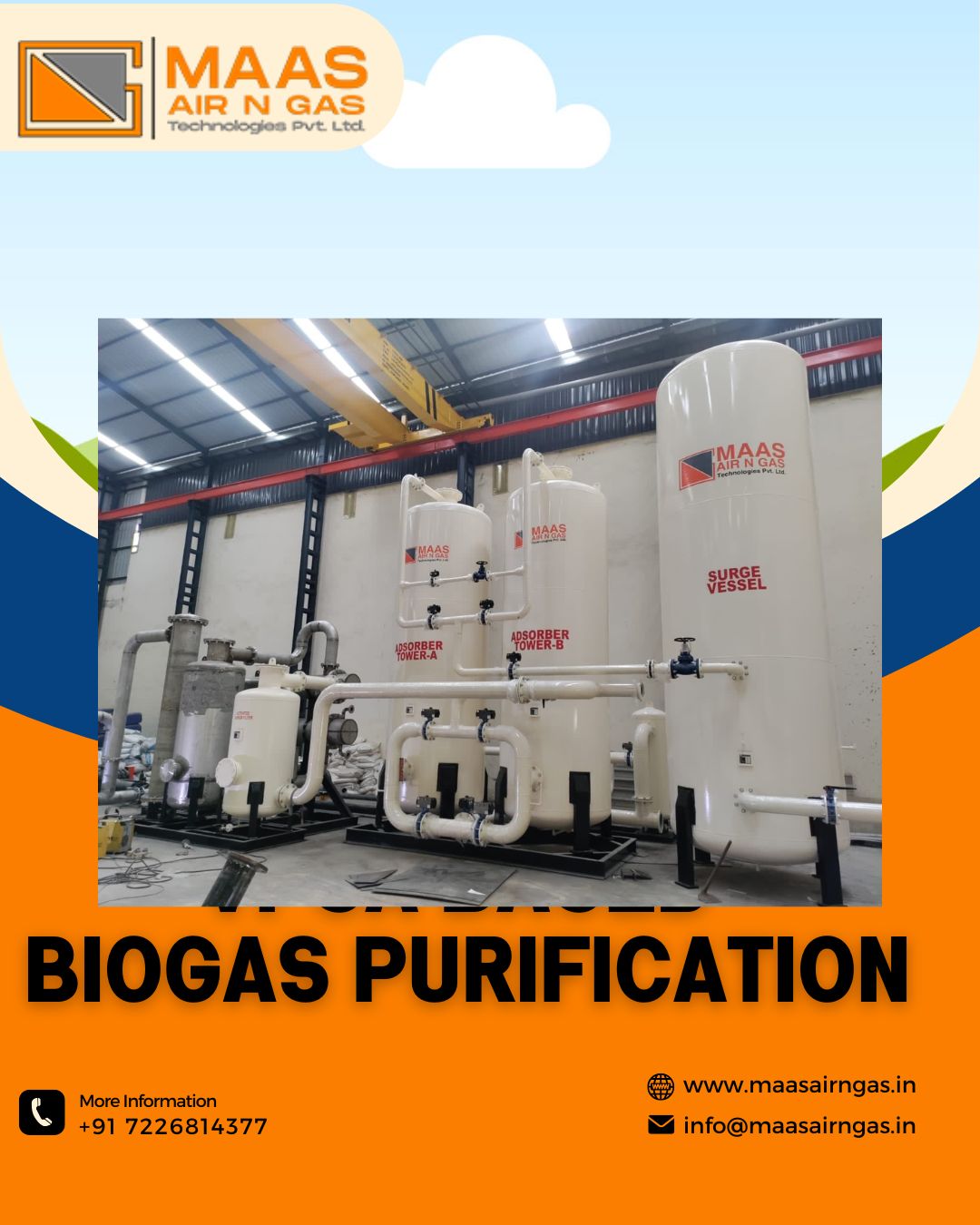
PSA Biogas Purification Plant: 7 Powerful Benefits for High-Quality Renewable Energy Production
Table of Contents
- What is a PSA Biogas Purification Plant?
- How Does a PSA Biogas Purification Plant Work?
- Key Components of a PSA Biogas Purification Plant
- Benefits of PSA Biogas Purification Plant Technology
- Industrial Applications of PSA Biogas Purification Plant
- Why Choose MAAS Air N Gas for PSA Biogas Purification Plant Solutions?
- Future of PSA Biogas Purification Plant in India
- FAQs
- Conclusion
PSA Biogas Purification Plant
As industries and governments across the world focus on sustainable energy solutions, the demand for a PSA Biogas Purification Plant continues to grow rapidly. Biogas generated from agricultural waste, food waste, municipal solid waste, sewage sludge, and organic residues contains valuable methane along with impurities such as carbon dioxide (CO?), hydrogen sulfide (H?S), moisture, and trace contaminants. To maximize its energy value and make it suitable for industrial applications, these impurities must be removed efficiently.
A PSA Biogas Purification Plant uses advanced Pressure Swing Adsorption (PSA) technology to separate unwanted gases from raw biogas and produce high-purity biomethane. This purified gas can be used as a renewable substitute for natural gas in industries, commercial facilities, transportation sectors, and power generation applications. As countries continue to invest in clean energy initiatives, PSA-based purification systems are becoming a preferred choice due to their reliability, efficiency, and cost-effectiveness.
What is a PSA Biogas Purification Plant?
A PSA Biogas Purification Plant is an advanced gas treatment system designed to upgrade raw biogas into high-purity biomethane. The technology utilizes specialized adsorbent materials that selectively capture carbon dioxide, moisture, hydrogen sulfide, and other contaminants while allowing methane to pass through.
The result is a significantly upgraded gas stream containing methane concentrations that can exceed 95%, depending on feed gas quality and system design. This purified biomethane can be compressed, stored, injected into gas grids, or utilized as a clean fuel alternative.
The growing focus on renewable energy and carbon emission reduction has increased the adoption of PSA Biogas Purification Plant systems in both developed and emerging economies. In India, government initiatives supporting compressed biogas production have further accelerated investments in this technology.
For national renewable energy initiatives and policies, refer to the Ministry of New and Renewable Energy (MNRE): Ministry of New and Renewable Energy (MNRE)
How Does a PSA Biogas Purification Plant Work?
The working principle of a PSA Biogas Purification Plant is based on pressure swing adsorption. Raw biogas first undergoes pre-treatment to remove moisture, particulate matter, and hydrogen sulfide. Once conditioned, the gas enters adsorption vessels filled with specialized adsorbent media.
Under high pressure, impurities such as carbon dioxide are adsorbed onto the media surface while methane continues through the system. When the adsorbent reaches saturation, the pressure is reduced, releasing the captured contaminants and regenerating the adsorbent for the next cycle.
The process continuously alternates between adsorption and regeneration phases, ensuring uninterrupted operation. This cyclic operation makes PSA technology highly efficient and suitable for large-scale biomethane production facilities.
The ability to achieve high methane recovery rates while maintaining low operational costs has made the PSA Biogas Purification Plant one of the most trusted solutions in the renewable gas industry.
Key Components of a PSA Biogas Purification Plant
A modern PSA Biogas Purification Plant consists of several integrated components working together to ensure optimal gas purification performance.
The pre-treatment section removes harmful contaminants before the gas reaches the adsorption system. Adsorber towers contain specially selected adsorbents responsible for separating impurities from methane. Surge vessels help stabilize pressure fluctuations and maintain process efficiency.
Control systems monitor plant performance in real time, enabling automated operation and minimizing operator intervention. Gas analyzers continuously verify methane purity, ensuring that the final biomethane meets application-specific requirements.
Advanced engineering and proper system integration play a crucial role in maximizing the performance and lifespan of a PSA Biogas Purification Plant.
Benefits of PSA Biogas Purification Plant Technology
The popularity of the PSA Biogas Purification Plant is driven by numerous technical and economic advantages.
One of the most important benefits is the production of high-purity biomethane suitable for commercial and industrial use. The system effectively removes carbon dioxide and other impurities, resulting in improved fuel quality and energy efficiency.
Another major advantage is operational reliability. PSA systems are known for their stable performance, minimal maintenance requirements, and long service life. This makes them ideal for continuous industrial operations where uptime is critical.
The technology is also environmentally beneficial. By converting organic waste into renewable energy, a PSA Biogas Purification Plant helps reduce greenhouse gas emissions and supports circular economy initiatives.
From an economic perspective, industries can reduce fuel costs by utilizing purified biomethane as an alternative to conventional fossil fuels. Many projects also qualify for government incentives and sustainability programs, improving overall project viability.
For additional information about biogas and renewable gas technologies, visit the International Energy Agency: International Energy Agency (IEA) Biogas Resources
Industrial Applications of PSA Biogas Purification Plant
The versatility of a PSA Biogas Purification Plant makes it suitable for a wide range of industries and sectors.
Municipal wastewater treatment facilities use PSA technology to upgrade biogas generated during sludge digestion. Agricultural operations convert livestock waste into biomethane, creating a valuable energy resource while addressing waste management challenges.
Food processing facilities benefit from renewable energy production by utilizing organic waste streams that would otherwise require disposal. Landfill operators can recover methane emissions and transform them into commercially valuable fuel.
In transportation applications, purified biomethane can be compressed into Bio-CNG and used as a sustainable vehicle fuel. Industrial plants can also utilize biomethane for boilers, furnaces, and power generation systems, reducing dependency on conventional natural gas supplies.
Why Choose MAAS Air N Gas for PSA Biogas Purification Plant Solutions?
When investing in a PSA Biogas Purification Plant, selecting an experienced technology provider is essential for long-term success. MAAS Air N Gas specializes in designing and manufacturing advanced gas purification systems tailored to diverse industrial requirements.
The company focuses on delivering reliable solutions with high methane recovery rates, energy-efficient operation, and robust construction. Every project is engineered according to client-specific feed gas characteristics, capacity requirements, and performance expectations.
MAAS Air N Gas provides complete support from design and manufacturing to installation, commissioning, and after-sales service. Their commitment to quality, innovation, and customer satisfaction has made them a trusted partner in the gas processing industry.
Future of PSA Biogas Purification Plant in India
India's renewable energy sector is experiencing significant growth, creating strong opportunities for PSA Biogas Purification Plant installations. Government programs promoting compressed biogas production and sustainable waste management are encouraging investments across multiple sectors.
As industries seek cleaner fuel alternatives and carbon reduction strategies, biomethane production is expected to play an increasingly important role in the country's energy transition. PSA technology will remain a key enabler due to its proven performance, scalability, and operational efficiency.
The integration of advanced automation, digital monitoring, and energy optimization technologies will further enhance the effectiveness of future PSA Biogas Purification Plant projects.
FAQs
What is a PSA Biogas Purification Plant?
A PSA Biogas Purification Plant is a system that upgrades raw biogas by removing carbon dioxide, moisture, hydrogen sulfide, and other impurities to produce high-purity biomethane.
What purity level can a PSA Biogas Purification Plant achieve?
Most modern PSA systems can achieve methane purity levels above 95%, depending on feed gas composition and system design.
Where is purified biomethane used?
Purified biomethane can be used in industrial boilers, power generation, gas grids, Bio-CNG production, and transportation fuel applications.
Why is PSA technology preferred for biogas upgrading?
PSA technology offers high methane recovery, reliable operation, lower maintenance requirements, and excellent purification performance.
Is a PSA Biogas Purification Plant environmentally friendly?
Yes. It converts waste-generated biogas into clean, renewable fuel, helping reduce greenhouse gas emissions and supporting sustainable energy goals.
Conclusion
A PSA Biogas Purification Plant is one of the most effective solutions for transforming raw biogas into high-value biomethane. By removing impurities and improving methane concentration, the technology enables industries, municipalities, and agricultural operations to utilize renewable energy more efficiently. With growing environmental awareness, government support, and increasing demand for sustainable fuels, investment in a PSA Biogas Purification Plant offers both economic and environmental advantages. Companies seeking reliable and advanced purification solutions can benefit from partnering with experienced providers such as MAAS Air N Gas to achieve long-term operational success and energy sustainability.