
Fully Automatic Biogas Upgradation Plant: 7 Powerful Benefits for High-Purity Bio-CNG Production
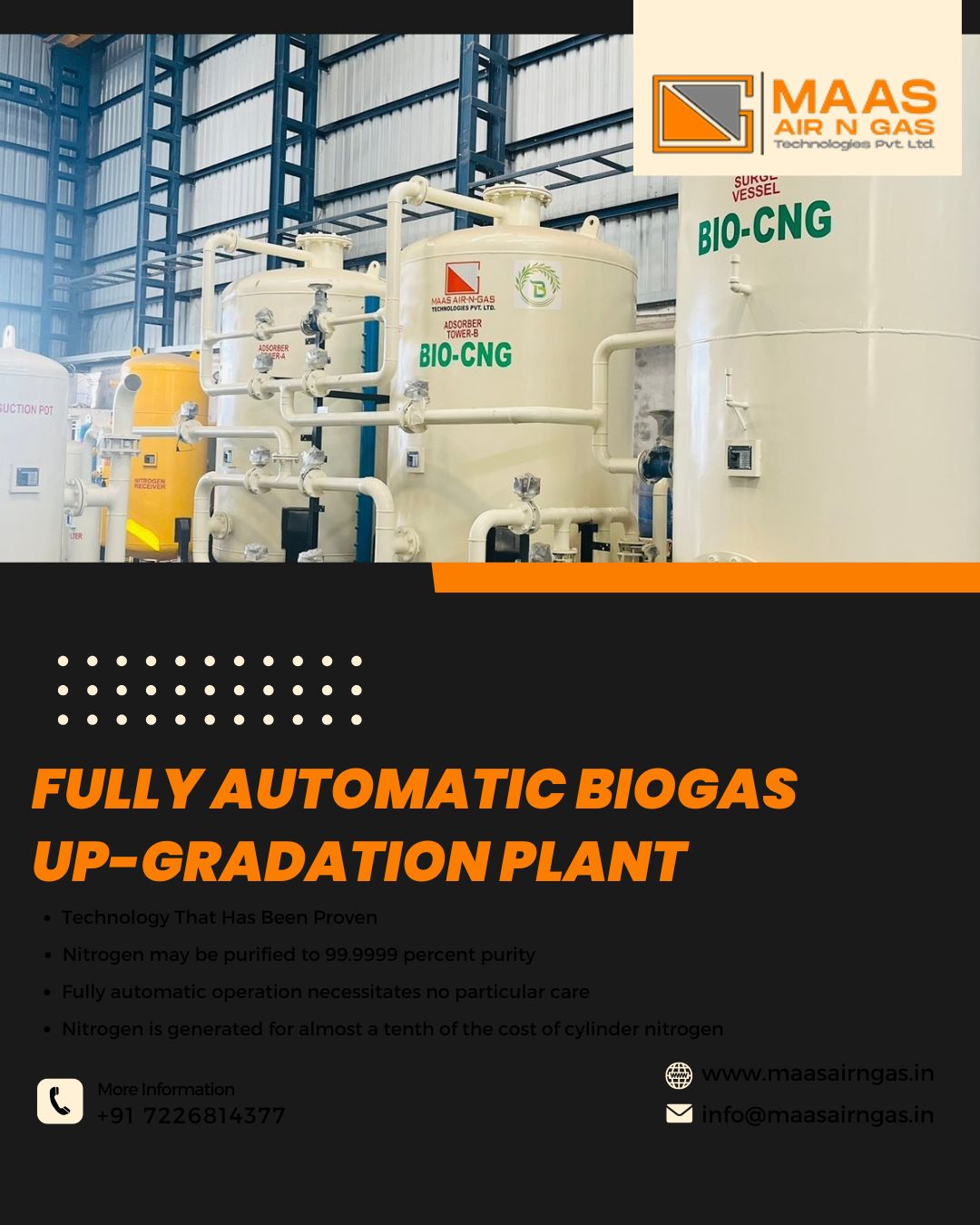
Table of Contents
- What is a Fully Automatic Biogas Upgradation Plant?
- Why Biogas Upgradation is Important
- How a Fully Automatic Biogas Upgradation Plant Works
- Key Features and Advantages
- Applications of Bio-CNG Production
- Why Choose MAAS Air N Gas Technologies?
- Future of Biogas Upgradation in India
- FAQ
- Conclusion
Fully Automatic Biogas Upgradation Plant: The Smart Solution for High-Purity Bio-CNG Production
The Fully Automatic Biogas Upgradation Plant is transforming the renewable energy industry by enabling businesses, industries, municipalities, and agricultural sectors to convert raw biogas into high-quality Bio-CNG efficiently and economically. As the world moves toward cleaner energy sources and reduced carbon emissions, advanced biogas purification systems have become essential for sustainable energy production.
Raw biogas generated from organic waste contains methane along with impurities such as carbon dioxide, hydrogen sulfide, moisture, and other trace gases. These impurities reduce fuel quality and limit its direct usability. A Fully Automatic Biogas Upgradation Plant removes unwanted contaminants and enhances methane concentration, resulting in Bio-CNG that can be used as a reliable alternative to conventional fossil fuels.
With increasing government support, environmental awareness, and rising fuel costs, the demand for automated biogas upgrading systems is growing rapidly across India and global markets. Industries are seeking efficient solutions that minimize operational complexity while maximizing gas purity and production efficiency.
What is a Fully Automatic Biogas Upgradation Plant?
A Fully Automatic Biogas Upgradation Plant is an advanced purification system designed to upgrade raw biogas into compressed Bio-CNG by removing carbon dioxide, hydrogen sulfide, moisture, and other impurities. The entire process is controlled through automated systems, reducing human intervention and ensuring consistent performance.
Modern plants use sophisticated technologies such as Pressure Swing Adsorption (PSA), membrane separation, water scrubbing, or chemical scrubbing to achieve high methane purity levels. Automation enables continuous monitoring of pressure, temperature, gas composition, and flow rates, ensuring optimal plant efficiency at all times.
The upgraded gas produced can be utilized for vehicle fuel, industrial heating, power generation, and pipeline injection, making it a versatile renewable energy solution.
Why Biogas Upgradation is Important
Biogas generated from agricultural waste, municipal solid waste, food processing residues, and sewage treatment plants contains only a limited percentage of methane. Without purification, its calorific value remains relatively low and unsuitable for many commercial applications.
A Fully Automatic Biogas Upgradation Plant enhances methane concentration significantly, improving fuel quality and energy output. The removal of harmful contaminants also protects downstream equipment from corrosion and damage, extending equipment lifespan and reducing maintenance costs.
Moreover, upgraded Bio-CNG helps reduce greenhouse gas emissions and supports national sustainability goals. According to the Government of India's Sustainable Alternative Towards Affordable Transportation (SATAT) initiative, Bio-CNG production is expected to play a major role in India's clean energy transition.
For more information about renewable energy initiatives, visit the official Government of India portal: https://mnre.gov.in/
How a Fully Automatic Biogas Upgradation Plant Works
The operation of a Fully Automatic Biogas Upgradation Plant begins with the collection of raw biogas from anaerobic digesters. This gas first passes through pre-treatment stages where moisture, particulates, and hydrogen sulfide are removed.
The purified gas then enters the upgrading section where advanced separation technology isolates carbon dioxide from methane. Pressure Swing Adsorption (PSA) technology is among the most preferred methods because of its reliability, efficiency, and ability to achieve high methane purity levels.
Once upgraded, the methane-rich gas is compressed and stored as Bio-CNG. The automation system continuously monitors critical parameters and automatically adjusts operating conditions to maintain optimal performance. This ensures uninterrupted production while minimizing operational costs.
Key Features of a Fully Automatic Biogas Upgradation Plant
A modern Fully Automatic Biogas Upgradation Plant offers numerous advantages that make it a preferred choice for commercial and industrial applications.
High Methane Recovery
The system maximizes methane recovery, ensuring greater fuel output from the same quantity of raw biogas. Higher methane concentration translates into better fuel efficiency and increased profitability.
Fully Automated Operation
Automation eliminates the need for constant manual supervision. Operators can monitor and control plant performance through advanced PLC and SCADA systems, improving reliability and reducing labor requirements.
Low Operating Cost
Energy-efficient components and optimized process design help reduce power consumption and maintenance expenses, making Bio-CNG production economically attractive.
Consistent Gas Quality
The plant continuously maintains desired methane purity levels, ensuring compliance with industry standards and delivering reliable fuel performance.
Environmentally Friendly Performance
By converting waste into clean energy, a Fully Automatic Biogas Upgradation Plant significantly reduces landfill waste and greenhouse gas emissions.
Applications of Bio-CNG Production
The growing adoption of Bio-CNG has created substantial demand for advanced biogas upgrading technologies. A Fully Automatic Biogas Upgradation Plant supports a wide range of applications across different industries.
In the transportation sector, Bio-CNG serves as a clean alternative fuel for buses, trucks, and commercial vehicles. Industrial facilities utilize Bio-CNG for boilers, furnaces, and process heating applications. Agricultural operations can convert crop residues and animal waste into valuable energy resources, creating additional revenue streams while improving waste management practices.
Municipal corporations and sewage treatment plants also benefit from biogas upgrading systems by transforming organic waste into renewable energy and supporting circular economy initiatives.
Why Choose MAAS Air N Gas Technologies?
When investing in a Fully Automatic Biogas Upgradation Plant, selecting an experienced technology provider is crucial for long-term success. MAAS Air N Gas Technologies has established itself as a trusted manufacturer and supplier of advanced gas generation, purification, and biogas upgrading solutions.
The company offers innovative technology backed by engineering expertise, ensuring superior performance, reliability, and operational efficiency. Their systems are designed to achieve high methane purity, low operating costs, and fully automated operation.
MAAS Air N Gas Technologies focuses on customized solutions tailored to specific project requirements, helping customers maximize return on investment while achieving sustainability objectives.
For additional insights into renewable gas technologies and global biogas developments, visit the International Energy Agency's bioenergy resources page: https://www.iea.org/
Explore more advanced gas purification solutions at https://www.air-n-gas.com/
Future of Fully Automatic Biogas Upgradation Plants in India
India possesses enormous potential for Bio-CNG production due to its vast agricultural base, livestock population, and growing urban waste generation. Government initiatives promoting renewable energy and waste-to-energy projects are expected to accelerate the deployment of Fully Automatic Biogas Upgradation Plants across the country.
As industries seek cleaner fuel alternatives and organizations prioritize sustainability goals, advanced biogas upgrading technologies will become increasingly important. Automation, digital monitoring, and energy-efficient purification systems will continue to drive innovation in this sector.
The combination of environmental benefits, economic advantages, and government support makes Bio-CNG one of the most promising renewable fuels for the future.
FAQ
What is a Fully Automatic Biogas Upgradation Plant?
A Fully Automatic Biogas Upgradation Plant is a system that removes impurities from raw biogas and increases methane concentration to produce high-quality Bio-CNG suitable for commercial and industrial applications.
What methane purity can be achieved?
Modern PSA-based systems can achieve methane purity levels exceeding 95% and, in some cases, even higher depending on project requirements.
Is Bio-CNG environmentally friendly?
Yes. Bio-CNG is a renewable fuel that reduces greenhouse gas emissions, supports waste management, and decreases dependence on fossil fuels.
Which industries can benefit from a Fully Automatic Biogas Upgradation Plant?
Agriculture, food processing, municipal waste management, transportation, wastewater treatment, and manufacturing industries can all benefit from Bio-CNG production.
Why is automation important in biogas upgrading?
Automation ensures stable performance, consistent gas quality, reduced labor requirements, lower operating costs, and improved plant safety.
Conclusion
A Fully Automatic Biogas Upgradation Plant is a powerful and future-ready solution for converting waste into valuable renewable energy. By upgrading raw biogas into high-purity Bio-CNG, these systems improve fuel quality, reduce environmental impact, and create sustainable economic opportunities. With advanced automation, high methane recovery, and reliable performance, the Fully Automatic Biogas Upgradation Plant has become an essential technology for organizations seeking cleaner energy solutions. Companies like MAAS Air N Gas Technologies are helping drive this transformation through innovative engineering and proven biogas purification expertise, making Bio-CNG production more efficient, profitable, and environmentally responsible.