
Ammonia Cracking Solutions: 7 Powerful Benefits of Green Hydrogen Made Practical
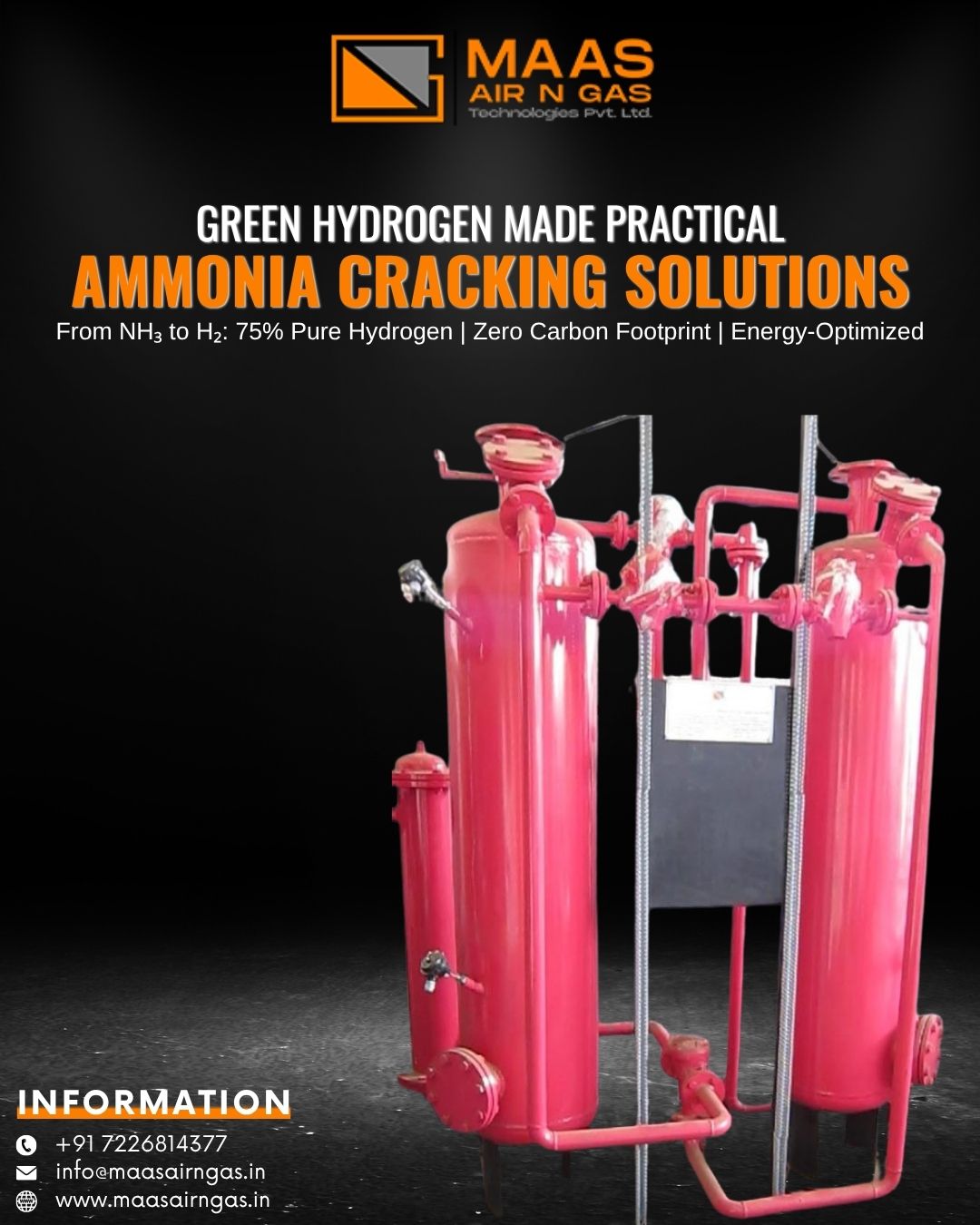
Ammonia Cracking Solutions: Green Hydrogen Made Practical for Modern Industries
Table of Contents
- What Are Ammonia Cracking Solutions?
- Why Ammonia Is Becoming Important in the Green Hydrogen Economy
- How Ammonia Cracking Solutions Work
- Composition of Cracked Ammonia Gas
- Industrial Applications of Ammonia Cracking Solutions
- Key Benefits of Ammonia Cracking Solutions
- Why Industries Prefer Ammonia Cracking Over Bulk Hydrogen Supply
- Ammonia Cracking Solutions and India’s Green Hydrogen Push
- How to Choose the Right Ammonia Cracker Manufacturer
- Why Choose MAAS Air N Gas
- Frequently Asked Questions
- Conclusion
Ammonia Cracking Solutions for Efficient Hydrogen Generation
Ammonia Cracking Solutions are becoming one of the most practical ways for industries to generate hydrogen-rich gas on demand without depending entirely on bulk hydrogen supply. As energy-intensive industries look for cleaner, more reliable, and more economical gas-generation methods, ammonia cracking has emerged as a highly relevant technology. It offers a proven route to convert ammonia into a usable gas mixture containing hydrogen and nitrogen, which is especially valuable in heat treatment, bright annealing, powder metallurgy, stainless steel processing, and several controlled-atmosphere industrial operations.
In simple terms, ammonia cracking is the thermal dissociation of anhydrous ammonia into hydrogen and nitrogen under controlled temperature and catalyst conditions. The output gas, commonly called cracked ammonia, generally contains 75% hydrogen and 25% nitrogen. This gas is dry, reducing in nature, and oxygen-free, which makes it highly useful for applications where oxidation control, metallurgical surface quality, and process consistency are critical.
As industries move toward low-carbon operations and greater process efficiency, Ammonia Cracking Solutions are gaining attention not only as a traditional industrial gas technology but also as a practical bridge in the broader green hydrogen ecosystem. For companies seeking hydrogen availability without the logistical complexity and cost of storing or transporting large volumes of pure hydrogen, ammonia cracking offers a smart operational alternative.
What Are Ammonia Cracking Solutions?
Ammonia Cracking Solutions refer to engineered systems designed to dissociate ammonia (NH?) into hydrogen (H?) and nitrogen (N?). These systems are commonly known as ammonia crackers or ammonia dissociation units. They are designed to receive anhydrous ammonia feed and convert it into a hydrogen-rich process gas that can be consumed directly in industrial applications.
The core purpose of these systems is to provide an on-site, dependable, and cost-effective hydrogen source. Instead of relying on external hydrogen cylinders, tube trailers, or cryogenic storage, industries can install an ammonia cracker and produce cracked gas where it is needed. This reduces dependence on external supply chains and improves operational continuity.
The significance of Ammonia Cracking Solutions lies in their practicality. Ammonia is easier to store and transport than hydrogen, and once cracked, it provides a hydrogen-rich gas suitable for several industrial processes. In sectors where reducing atmospheres are essential, this technology has been used for years. Today, however, it is being re-evaluated through the lens of sustainability, energy security, and the green hydrogen transition.
Why Ammonia Is Becoming Important in the Green Hydrogen Economy
Hydrogen is widely viewed as a strategic clean-energy fuel and industrial feedstock for the future. However, storing and transporting hydrogen remains a challenge due to its low volumetric energy density and demanding handling requirements. This is where ammonia enters the picture.
Ammonia is increasingly seen as an efficient hydrogen carrier. It can be liquefied more easily than hydrogen, transported using existing infrastructure, and then converted back into hydrogen-rich gas near the point of use. This makes ammonia a practical vector for hydrogen movement across industrial supply chains. As a result, Ammonia Cracking Solutions are no longer limited to conventional furnace applications; they are also becoming relevant to conversations around hydrogen distribution, decentralized hydrogen use, and future clean-fuel ecosystems.
India’s policy environment is also moving in this direction. Under the National Green Hydrogen Mission, the government aims to accelerate production, usage, and export of green hydrogen and its derivatives such as green ammonia. This is important because if green ammonia becomes more widely available, ammonia cracking can serve as a practical downstream technology for industries that need hydrogen-rich gas on-site. The policy backdrop strengthens the long-term relevance of Ammonia Cracking Solutions in India’s industrial and energy landscape.
For a government reference on India’s hydrogen roadmap, you can refer to the National Green Hydrogen Mission by MNRE.
How Ammonia Cracking Solutions Work
The working principle behind Ammonia Cracking Solutions is straightforward but highly engineered in practice. Anhydrous ammonia is introduced into the cracking unit, where it passes through a heated dissociation chamber filled with catalyst. At elevated temperatures, ammonia decomposes according to the reaction:
2NH? ? N? + 3H?
This means ammonia breaks down into nitrogen and hydrogen. The resulting cracked gas typically contains around 75% hydrogen and 25% nitrogen, depending on operating conditions and system design. The gas then passes through cooling and conditioning stages before being supplied to the end-use process.
A well-designed ammonia cracker is not just a heater with a catalyst chamber. It is an integrated process system that typically includes:
- ammonia inlet arrangement and control system
- dissociation chamber or retort
- catalyst bed
- electric or fuel-fired heating arrangement
- temperature and pressure controls
- cooling and gas outlet section
- safety devices and process instrumentation
The efficiency of Ammonia Cracking Solutions depends on correct temperature control, catalyst performance, gas-tight design, and overall system engineering. Industrial users generally expect a system that can operate continuously, maintain process stability, and deliver gas of consistent quality for furnace and process applications.
Composition of Cracked Ammonia Gas
One of the reasons Ammonia Cracking Solutions remains so useful in industry is the composition of the gas they produce. Cracked ammonia typically contains:
- Hydrogen (H?): approximately 75%
- Nitrogen (N?): approximately 25%
This gas mixture is dry and reducing in nature, which makes it especially suitable for metallurgical operations requiring protection from oxidation. In many heat-treatment environments, the hydrogen content helps create the reducing atmosphere needed to maintain product quality, brightness, and surface integrity.
Because the output gas is generated on-site, users gain better control over availability and process continuity. For many industrial applications, cracked ammonia offers a practical balance between performance and economics.
Industrial Applications of Ammonia Cracking Solutions
The industrial value of Ammonia Cracking Solutions is tied directly to their application versatility. These systems are widely used in sectors where hydrogen-rich atmospheres are required for thermal or metallurgical processing. One of the most common uses is in heat treatment furnaces, where cracked ammonia is employed to create a reducing atmosphere that helps prevent oxidation during annealing, brazing, sintering, and hardening operations.
In bright annealing applications, particularly in stainless steel and non-ferrous processing, cracked ammonia helps preserve surface finish and maintain brightness. In powder metallurgy, it is used to support sintering operations where the atmosphere quality has a direct effect on mechanical properties and component quality. In electronics and specialty manufacturing, hydrogen-rich atmospheres can also be useful in specific thermal processes where contamination and oxidation must be minimized.
Another important application area is wherever pure hydrogen is technically useful but commercially expensive to source in bulk. In such cases, Ammonia Cracking Solutions provides a cost-effective substitute by generating a hydrogen-rich gas at the point of use. This is one of the main reasons ammonia crackers continue to be valued across a wide range of industrial sectors.
Key Benefits of Ammonia Cracking Solutions
1. Cost-Effective Hydrogen-Rich Gas Generation
One of the strongest advantages of Ammonia Cracking Solutions is economics. In many industrial situations, purchasing pure hydrogen in cylinders or bulk can be expensive and logistically inconvenient. Ammonia cracking offers a more practical route to obtain a hydrogen-rich gas mixture on-site, reducing recurring supply costs and improving process economics.
2. On-Site Gas Availability
When industries generate gas at their own facility, they reduce dependence on third-party hydrogen supply schedules. This improves reliability and lowers the risk of production interruptions. For plants with continuous furnace operations, this is a major operational benefit.
3. Dry and Oxygen-Free Reducing Atmosphere
Cracked ammonia is widely preferred in metallurgical processes because it is dry and reducing. This supports oxidation control, better surface finish, and improved process consistency in applications such as annealing and sintering.
4. Practical Hydrogen Carrier Route
Ammonia is easier to handle, transport, and store compared to hydrogen in many cases. As hydrogen markets develop, Ammonia Cracking Solutions are likely to become even more relevant because they fit into the broader concept of ammonia as a hydrogen carrier.
5. Lower Dependence on Bulk Hydrogen Infrastructure
Installing an ammonia cracker can reduce the need for large-scale hydrogen storage and recurring cylinder logistics. This is particularly useful for mid-sized industrial units that require a steady hydrogen-rich atmosphere but do not want to invest in complex hydrogen handling infrastructure.
6. Suitable for Continuous Industrial Duty
A properly engineered ammonia cracker is built for industrial service. With correct controls, robust construction, and good-quality components, these systems can support demanding production environments with stable gas output.
7. Alignment with Cleaner Industrial Transition
Although the environmental benefit depends on the source of ammonia, the broader market direction toward green ammonia and green hydrogen increases the long-term relevance of Ammonia Cracking Solutions. As green ammonia production scales up, cracking technology can become part of a cleaner industrial gas ecosystem.
Why Industries Prefer Ammonia Cracking Over Bulk Hydrogen Supply
In many cases, the decision between purchasing hydrogen and installing Ammonia Cracking Solutions comes down to practicality. Bulk hydrogen is effective, but it can involve transport constraints, storage requirements, safety planning, and fluctuating supply costs. For facilities located away from major industrial gas supply hubs, these challenges can become even more pronounced.
Ammonia, by contrast, is a well-established industrial chemical with mature storage and transport systems. When an industrial plant can safely receive ammonia and convert it on-site into cracked gas, it gains a more controlled and often more economical hydrogen supply route. The result is better process independence, fewer supply interruptions, and potentially lower long-term operating costs.
This is particularly relevant for facilities with predictable hydrogen-rich atmosphere requirements. Instead of repeatedly purchasing hydrogen from outside, they can treat Ammonia Cracking Solutions as part of their core process infrastructure.
Ammonia Cracking Solutions and India’s Green Hydrogen Push
India is steadily building a policy and investment framework around hydrogen and ammonia. The National Green Hydrogen Mission aims to position the country as a major producer, user, and exporter of green hydrogen and its derivatives. Government documents also emphasize demand creation for green ammonia and green hydrogen in the industry.
This matters because Ammonia Cracking Solutions sit at an important practical intersection. They connect the upstream world of ammonia production with the downstream reality of industrial gas consumption. As green ammonia becomes more available, industries may increasingly explore ammonia cracking as a way to access hydrogen-rich gas without overhauling their entire plant gas infrastructure.
In other words, ammonia cracking can serve as a useful bridge between current industrial requirements and the future hydrogen economy. For companies looking to modernize gradually rather than through a full hydrogen infrastructure shift, this technology offers a workable transition path.
How to Choose the Right Ammonia Cracker Manufacturer
Selecting the right supplier for Ammonia Cracking Solutions is not just about price. The quality of the system design, materials, controls, and after-sales support can directly affect gas quality, uptime, and lifecycle cost. Buyers should look for a manufacturer that understands both the gas-generation side and the end-use process side.
The first factor to assess is application understanding. A reliable manufacturer should understand how the cracked gas will be used—whether in bright annealing, heat treatment, brazing, or another application—because this affects system sizing and operating parameters. The second factor is engineering quality, including retort design, catalyst suitability, heating system efficiency, and control reliability. The third is service support, since industrial gas systems must be maintained for stable long-term performance.
It is also wise to evaluate whether the manufacturer offers related industrial gas systems, since this usually reflects broader process expertise. A company active in gas generators, dryers, and associated gas-treatment systems is often better positioned to deliver an integrated industrial solution rather than just a standalone machine.
Why Choose MAAS Air N Gas for Ammonia Cracking Solutions
When industries invest in Ammonia Cracking Solutions, they need more than a product brochure—they need a supplier that understands industrial gas systems, process reliability, and application-specific performance. This is where MAAS Air N Gas / Air-N-Gas stands out as a specialized Indian manufacturer in the gas-generation and air-treatment segment.
MAAS Air N Gas offers ammonia cracker systems as part of its wider industrial gas technology portfolio. The company’s product range and industrial focus indicate experience in serving sectors that require dependable gas generation, compressed air treatment, and process-support equipment. Its ammonia cracker offering is positioned for industries that need 75% hydrogen and 25% nitrogen cracked ammonia gas for heat treatment and reducing atmosphere applications.
Another reason to consider MAAS Air N Gas is the practical value of working with a company that already operates in adjacent process technologies such as PSA gas generators, compressed air dryers, and industrial gas systems. This broader experience often translates into better understanding of plant conditions, gas purity expectations, integration requirements, and long-term service needs.
If your plant is looking for a dependable solution for hydrogen-rich gas generation, MAAS Air N Gas can be evaluated not only as an equipment vendor but as a process-technology partner with a focused industrial offering.
Frequently Asked Questions About Ammonia Cracking Solutions
1. What are Ammonia Cracking Solutions used for?
Ammonia Cracking Solutions are used to convert ammonia into a hydrogen-rich gas mixture containing hydrogen and nitrogen. This gas is commonly used in heat treatment, bright annealing, brazing, powder metallurgy, and other industrial processes requiring a dry reducing atmosphere.
2. What gas composition is produced by an ammonia cracker?
A standard ammonia cracker generally produces cracked ammonia gas containing 75% hydrogen and 25% nitrogen. This composition makes it suitable for many metallurgical and thermal processing applications.
3. Are Ammonia Cracking Solutions a replacement for pure hydrogen?
In many industrial applications, yes. Where a hydrogen-rich reducing gas is sufficient, Ammonia Cracking Solutions can serve as a cost-effective alternative to purchasing pure hydrogen in cylinders or bulk supply.
4. Is ammonia cracking relevant to green hydrogen?
Yes. Ammonia is increasingly being considered a carrier for hydrogen, especially in the context of clean-energy supply chains. As green ammonia production grows, Ammonia Cracking Solutions can become an important downstream technology for industries that need hydrogen-rich gas on-site.
5. How do I choose the right ammonia cracker?
You should evaluate operating capacity, gas requirement, process application, energy efficiency, safety features, automation level, and the manufacturer’s service capability. Choosing an experienced industrial gas systems company is important for long-term reliability.
Conclusion
Ammonia Cracking Solutions are no longer just a conventional industrial gas technology; they are increasingly relevant to the future of practical hydrogen use. For industries that need a dependable, dry, hydrogen-rich atmosphere, ammonia cracking offers a proven and economical route. It reduces dependence on external hydrogen supply, supports continuous industrial operation, and aligns well with emerging interest in ammonia as a hydrogen carrier.
As India expands its green hydrogen and green ammonia ecosystem, the importance of flexible, plant-level hydrogen utilization technologies is likely to grow. In that context, Ammonia Cracking Solutions provides a strong balance of process efficiency, operational practicality, and future relevance. For manufacturers, heat-treatment companies, and process industries seeking a reliable source of cracked ammonia gas, choosing the right system and the right supplier becomes critical.
If your requirement is an industrially robust ammonia cracker designed for performance and reliability, MAAS Air N Gas is a strong option to consider for Ammonia Cracking Solutions in India.