
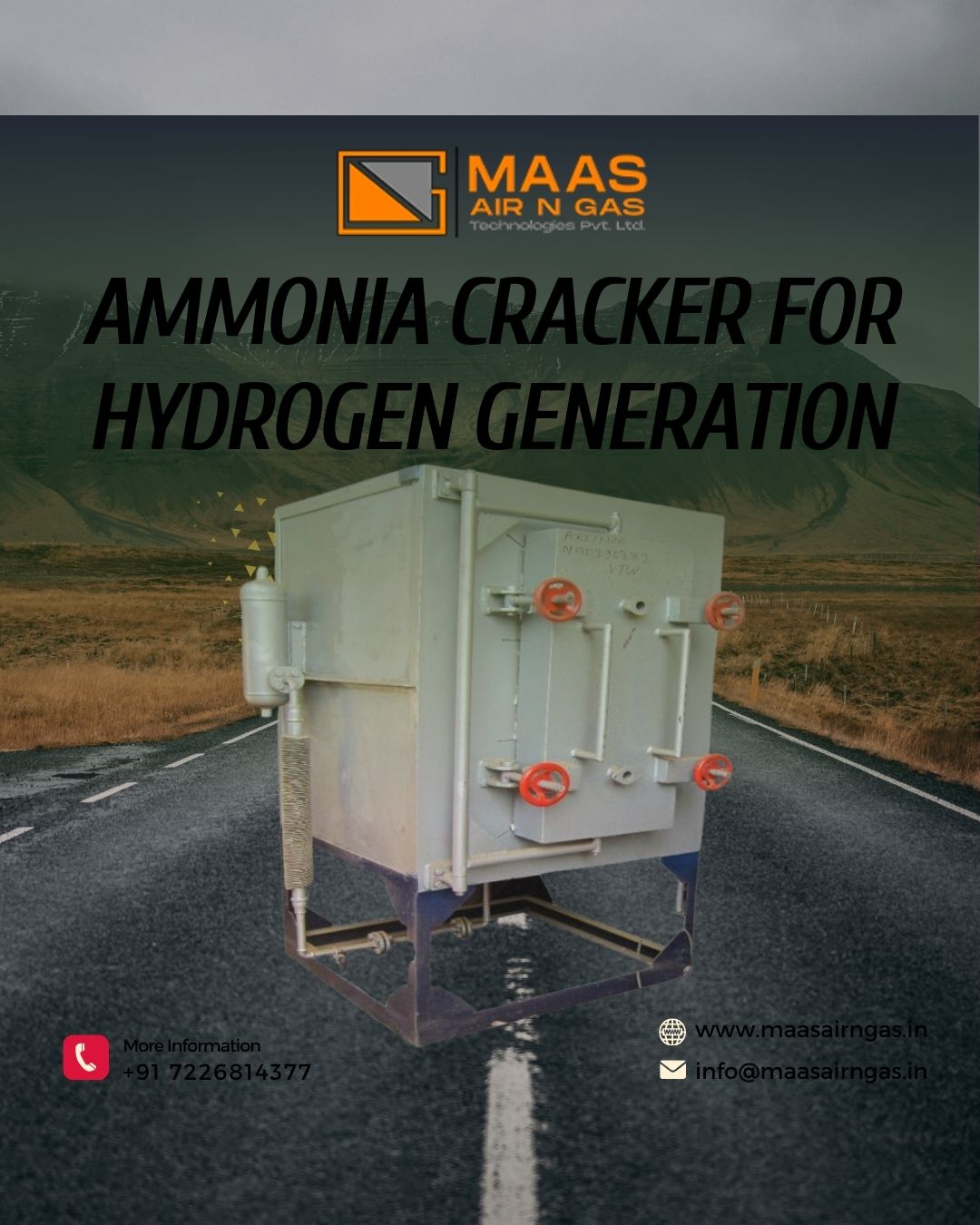
Ammonia Cracker for Hydrogen Generation: An Efficient Solution for On-Site Hydrogen Production
Introduction
Hydrogen plays a vital role in numerous industrial processes, including heat treatment, metal processing, electronics manufacturing, and chemical production. As industries seek reliable and cost-effective hydrogen sources, ammonia cracking technology has emerged as a practical solution for producing hydrogen directly at the point of use.
An Ammonia Cracker for Hydrogen Generation converts ammonia into a hydrogen-rich gas mixture through a controlled thermal dissociation process. This method offers a dependable supply of hydrogen while reducing the complexities associated with storing and transporting hydrogen cylinders.
This article explores the working principle, key features, advantages, applications, and considerations associated with ammonia cracking systems used for hydrogen generation.
Table of Contents
| Sr. No. | Topics |
|---|---|
| 1 | Introduction to Ammonia Cracker Technology |
| 2 | What is an Ammonia Cracker? |
| 3 | Working Principle |
| 4 | Key Features |
| 5 | Benefits of Hydrogen Generation from Ammonia |
| 6 | Major Components |
| 7 | Industrial Applications |
| 8 | Why Industries Choose Ammonia Cracking Systems |
| 9 | Factors to Consider Before Installation |
| 10 | Future Scope |
| 11 | Conclusion |
| 12 | FAQs |
Introduction to Ammonia Cracker Technology
Hydrogen is widely used as a protective and reducing atmosphere in various industrial operations. However, handling pure hydrogen can be challenging due to storage and transportation requirements.
Ammonia cracking technology addresses this challenge by producing hydrogen-rich gas on-site through the decomposition of ammonia. The resulting gas mixture contains hydrogen and nitrogen, making it suitable for numerous industrial applications.
What is an Ammonia Cracker?
An ammonia cracker is a specialized industrial system that thermally dissociates ammonia into hydrogen and nitrogen using a catalyst at elevated temperatures.
The generated gas mixture generally contains approximately:
| Gas Component | Typical Composition |
|---|---|
| Hydrogen | 75% |
| Nitrogen | 25% |
This hydrogen-rich atmosphere is commonly utilized in heat treatment and metallurgical processes.
Working Principle
The hydrogen generation process follows a series of controlled stages.
Ammonia Supply
Liquid ammonia is supplied to the system through a regulated feed mechanism.
Vaporization Process
The ammonia is converted into vapor before entering the cracking chamber.
Catalytic Dissociation
The ammonia vapor passes through a heated catalyst bed where it decomposes into hydrogen and nitrogen.
Cooling and Gas Treatment
The generated gas is cooled and conditioned for industrial use.
Gas Delivery
The hydrogen-rich gas mixture is supplied directly to the required process.
Key Features
Automated Operation
Advanced control systems enable smooth and consistent plant performance.
Continuous Gas Production
Provides a stable supply of hydrogen-rich gas for industrial applications.
High Process Reliability
Designed for dependable operation under demanding industrial conditions.
Compact Design
Requires comparatively less installation space.
Energy-Efficient Performance
Optimized heating systems help improve operational efficiency.
Durable Construction
Engineered using quality materials for long service life.
Low Maintenance Requirements
Simplified system design contributes to reduced maintenance needs.
Benefits of Hydrogen Generation from Ammonia
Cost-Effective Hydrogen Supply
Produces hydrogen on-site, reducing dependence on delivered gas cylinders.
Improved Process Control
Ensures a consistent atmosphere for critical industrial operations.
Reduced Storage Challenges
Minimizes the need for large-scale hydrogen storage systems.
Enhanced Operational Efficiency
Supports uninterrupted production processes with continuous gas availability.
Reliable Performance
Provides stable gas quality for various manufacturing applications.
Major Components
Ammonia Vaporizer
Converts liquid ammonia into vapor form before processing.
Cracking Furnace
Provides the required temperature for ammonia dissociation.
Catalyst Chamber
Facilitates the decomposition reaction.
Cooling System
Reduces gas temperature before delivery.
Gas Purification Section
Improves gas quality where required by specific applications.
Control Panel
Monitors and controls operational parameters.
Industrial Applications
Ammonia cracking systems are used across a wide range of industries.
Heat Treatment Industry
Provides protective atmospheres for annealing and hardening processes.
Bright Annealing Operations
Supports oxidation-free metal treatment.
Powder Metallurgy
Used for sintering and controlled atmosphere processing.
Stainless Steel Manufacturing
Helps maintain product quality during thermal processing.
Electronics Industry
Supports specialized manufacturing environments.
Chemical Processing
Used in processes requiring hydrogen-rich atmospheres.
Why Industries Choose Ammonia Cracking Systems
Industries prefer ammonia-based hydrogen generation because it offers a practical balance between performance, reliability, and operating efficiency.
Consistent Gas Availability
Supports continuous industrial production.
Lower Logistics Dependence
Reduces reliance on external hydrogen suppliers.
Simplified Operations
Enables convenient on-site gas generation.
Long-Term Cost Benefits
Can provide operational savings compared to traditional supply methods.
Factors to Consider Before Installation
Hydrogen Demand
Evaluate daily and hourly gas consumption requirements.
Available Installation Space
Ensure adequate space for equipment and maintenance access.
Utility Requirements
Assess power and other supporting utility needs.
Safety Measures
Implement appropriate operational and monitoring systems.
Future Expansion Plans
Consider scalability to meet future production growth.
Future Scope
As industrial demand for hydrogen continues to increase, ammonia cracking technology remains an important solution for on-site hydrogen production. Growing adoption in heat treatment, metallurgy, and advanced manufacturing sectors is expected to drive further utilization of these systems.
The ability to generate hydrogen efficiently and reliably positions ammonia cracking as a valuable technology for modern industrial operations.
Conclusion
An Ammonia Cracker for Hydrogen Generation provides a practical and efficient method of producing hydrogen-rich gas for industrial applications. By converting ammonia into usable hydrogen and nitrogen, these systems help improve operational reliability, reduce logistical challenges, and support consistent manufacturing performance.
For industries seeking dependable hydrogen generation solutions, ammonia cracking technology continues to be a proven and effective choice.
FAQs
What is an ammonia cracker used for?
An ammonia cracker is used to generate hydrogen-rich gas by decomposing ammonia into hydrogen and nitrogen.
How does ammonia cracking produce hydrogen?
The process uses heat and a catalyst to dissociate ammonia into its constituent gases.
Which industries commonly use ammonia cracking systems?
Heat treatment, metallurgy, electronics, stainless steel manufacturing, and chemical processing industries frequently use these systems.
What gases are produced during ammonia cracking?
The process primarily produces hydrogen and nitrogen.
Is on-site hydrogen generation beneficial?
Yes, it helps reduce dependence on external gas supplies and provides continuous availability.
Does an ammonia cracker require significant maintenance?
Modern systems are designed for reliable operation with relatively low maintenance requirements.
Can ammonia cracking systems operate continuously?
Yes, they are commonly designed for continuous industrial operation.
What are the key advantages of ammonia cracking technology?
Reliable hydrogen production, operational efficiency, continuous gas supply, and reduced logistics dependence are among the primary advantages.